I am a materialist. In the past that would be putting myself down. It would be confessing that I was shallow, attentive to consumer goods at the expense of spiritual and intellectual pursuits. Being a materialist means something different to me now—more like keeping engaged to the physical world and appreciating the beauty in objects. On a superficial level, my materialism is expressed through the appreciation of vinyl records, with their often creative covers, well-written and informative liner notes, and high-quality mastering. MP3s and other digital music formats don’t exist in a physical world. Our engagement to the music has been reduced to an immaterial context. The way music is presented now provides fewer opportunities for creativity.
Another example of the contrast between the material and immaterial worlds we live in are childhood war games. As a boy, I often played war games with other boys in the neighborhood. We would use construction sites or the woods as battlefields. We used baseball bats as rifles, empty beer cans discarded by construction workers as grenades. We had to make up a narrative and adopt roles to set the action. It was fun crawling through the dirt, pretending a Louisville Slugger was an M-16, on a sneak attack on an imaginary fort. It was an extremely physical game and at the same time it was extremely imaginative. There were a lot of details we had to fill in ourselves to make the war seem real to us.
You probably know where I’m going with this. Video war games provide you with none of the physical engagement of the war game described above, and perhaps more importantly all the details are filled in for the player, leaving little room for the imagination. Video games are little more than elaborate and virtual mazes. The games are about directional choices the player makes and his dexterity in overcoming obstacles.
So in my current view, materialism doesn’t stand opposite of the intellectual and the imaginative or even the spiritual. The physical world co-exists necessarily with the spiritual and intellectual world. It is the immaterial world of video games and digital music that is a step removed from the intellectual, imaginative, and spiritual aspects of life that we value. In this modern context, materialism isn’t such a bad thing.
Thursday, March 22, 2012

Sunday, March 18, 2012
Album Cover Gallery: Novel Covers
Special edition of Talking Heads' Speaking in Tongues designed by Robert Rauschenburg: The album comes in a yellow transluscent case. The vinyl is actually clear. The design you see are on two circular transparencies that go on either side of the record. Artsy fartsy.


First US pressing of Rolling Stones' Their Satanic Majesties Request has a lenticular plastic 3-D image of the band (which is hard to capture in a photo)--artsy fartsy in the mind of a 13-year old boy.

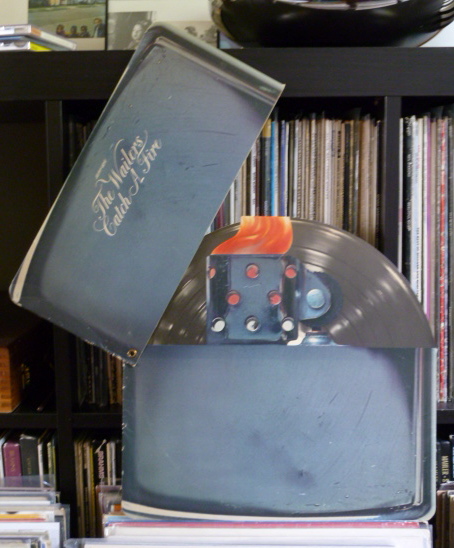
First UK pressing of Bob Marley's Catch a Fire has a cover designed like a Zippo lighter. It flips open like a Zippo, too! Fuck art. Let's light up, man.


First US pressing of Rolling Stones' Their Satanic Majesties Request has a lenticular plastic 3-D image of the band (which is hard to capture in a photo)--artsy fartsy in the mind of a 13-year old boy.

First UK pressing of Bob Marley's Catch a Fire has a cover designed like a Zippo lighter. It flips open like a Zippo, too! Fuck art. Let's light up, man.

Friday, March 2, 2012
Primary System vs. Vintage System
I've been really enamored with the vintage system set up in the bedroom. It's just so pleasing to listen to that I had thoughts that it was all I needed. Who needs a hi-fi system that has a price tag of a mid-sized car? Well, last night I listened to a couple of records on my primary system, Bobby Hutcherson and Harold Land's San Francisco (original Blue Note pressing) and Neu! 2 (original UK United Artists pressing). Then I moved to the bedroom to listen to the vintage system before turning in for the night. This wasn't an intentional comparison, but it was the first time I listened to the two systems back-to-back. The vintage system sounded muffled, less clear, and the sound-stage was smaller and less defined compared to the primary system. The bass was also boomier and less defined. When I first listened to the vintage system I was surprised how close it came to the sound quality of my primary system. Last night I realized that impression was obviously an illusion. So, critical listening will be done on the primary system. The vintage system is perfect for casual listening in the bedroom. One advantage it does have is it does take the digital edge off many modern recordings and makes them more listenable. The comparison with the primary system hasn't diminished my appreciation of the vintage system. It still sounds wonderful. My appreciation of the primary system has only increased.
Sunday, February 26, 2012
Slightly Off Topic: Polaroids
 A running theme of this blog has been the superiority of vinyl music reproduction to current digital music formats. I'm convinced that it's not an exercise in nostalgia, where one clings to an outdated inferior technology for sentimental reasons. Well, there's the nostalgia, too. But there's no doubt that vinyl records just sound better. The market has abandoned records and turntables for other reasons--lack of convenience, better profits in digital music (ironically that didn't work out as it opened the pirating floodgates), and just a general tendency of the market to push and the public to adopt the new, new thing.
Another technology that I was sad to see abandoned was Polaroid film. Sure, there are countless advantages of digital photography over film photography, including Polaroids, but one thing the Polaroid had over digital imaging and other films was its magic. Who didn't have a sense of wonder the first time seeing an image appear right before their eyes on that plasticky sheet of Polaroid film.
I recently picked up a Polaroid OneStep CloseUp camera at a thrift store. It looks to be in good shape. Of course, I'll need some Polaroid 600 film. Fortunately a company called The Impossible Project, consisting of former Polaroid workers, bought the last Polaroid factory and resumed making Polaroid film. I've ordered a pack to test out the camera and, more importantly, to find out if there's still magic in the technology.
Monday, February 20, 2012
Going Vintage: Salvaging the 70s
My audio project of assembling a vintage system had been stalled for a while now. A few years ago I started with a pair of 70s era KLH Model 17 speakers with a linen-like cloth grill and real wood veneer cabinet. I then picked up a 70s era Thorens TD-160 turntable. I had everything hooked up to an integrated amp bought new in the late 90s, which looked out of place. Recently I got extra motivated to complete the vintage system. I finally found a 70s era Marantz 2275 receiver with a walnut veneer cabinet to go with the turntable and speakers. And, whoa, she's a beauty!

Only if CD Players were made in the 60s and 70s. My California Audio Labs cd player looks plain-janey on top of the Marantz receiver. Grado SR-80 head-phones (shown on top) always had a retro look.

Swiss-made precision, the Thorens TD-160, spinning Detroit-made rock, Bob Seger's Night Moves.

KLH 17s designed by legendary speaker designer Henry Kloss before he sold the company to some foreign conglomerate that succeeded in equating the KLH brand to cheap plastic crapola.
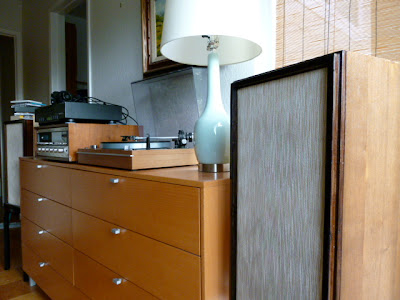 The vintage system is set up in the bedroom. It sounds and looks fantastic. The total cost of this system is about how much I spent on the speaker wires for my main system!

Only if CD Players were made in the 60s and 70s. My California Audio Labs cd player looks plain-janey on top of the Marantz receiver. Grado SR-80 head-phones (shown on top) always had a retro look.

Swiss-made precision, the Thorens TD-160, spinning Detroit-made rock, Bob Seger's Night Moves.

KLH 17s designed by legendary speaker designer Henry Kloss before he sold the company to some foreign conglomerate that succeeded in equating the KLH brand to cheap plastic crapola.
 The vintage system is set up in the bedroom. It sounds and looks fantastic. The total cost of this system is about how much I spent on the speaker wires for my main system!
 Sunday, February 5, 2012
Chance Discovery: Clyde McCoy
Last week, I picked up an old Mercury 10-inch jazz record by Clyde McCoy. For 50 cents I was willing to find out what was in the grooves. If McCoy's name sounds familiar, it's because he was a member of the McCoy clan that feuded with the Hatfields. Or, if you're into the history of electric guitars, you may know that the first wah-wah pedal was named after him, because it simulated the wah-wah effect that he mastered on the trumpet using a mute. McCoy also co-founded the venerable jazz magazine Downbeat.
According to Wikipedia, McCoy's best known song "Sugar Blues", which sounds like straight bluesy jazz to me, topped the "country (hillbilly)" music charts. Here's another example of how the borders of country music was wide open in the past (see previous post on the hardening of the boundaries between country and R&B music). Later, the song was recorded by country artists such as Bob Wills and the Texas Playboys and used in the movie Some Like It Hot.
It's all a wonderful bit of music history learned from a random record purchase.
Friday, February 3, 2012
Snobs vs. Connoisseurs
In case you didn't know:
Sonus Faber is an Italian speaker manufacturer that makes speakers that range in price from a couple thousand dollars to tens of thousand dollars. Their speakers do everything right that Bose speakers don’t. However, I don’t like Sonus Faber speakers. They have a sonic character that I find is a little too lush and dark for my taste. SF speakers don’t distort the music, but they definitely have a certain sound (just as some musicians say an Amati violin sound different from a Stradivarius. Both violins produce correct notes, but have slightly different sonic character.) I ended up buying German-made Audio Physic speakers after auditioning them next to Sonus Faber speakers. At this level, it would be ridiculous to claim AP speakers are superior to SF speakers. It’s only a personal preference. People who are willing to make the claim of the superiority of one brand over the other cross the line from being a connoisseur to being a snob.

Is there such a thing as perfect taste? No. Taste just comes down to preferences. It makes no sense to claim one has perfect preferences. That’s my definition of a snob—a person who believes his taste is superior to others and by inference he is better than others. Snobs are insufferable. Contrast that to someone who can discern and appreciate quality based on knowledge. I call this person a connoisseur.
Let’s consider audio speakers to illustrate the distinction. There are people who think Bose speakers are high quality, high fidelity speakers. Bose speakers obviously are not. Even the most expensive Bose speakers have bloated, undefined bass, can’t convincingly reproduce a coherent soundstage, and can’t convey dynamic subtleties in the recording. I’m not being a snob, because I’ve heard speakers that reproduce music much better than Bose speakers. The people who think Bose speakers are great, I believe, fall for the superior marketing of the company and haven’t been exposed to true high fidelity speakers.
Sonus Faber is an Italian speaker manufacturer that makes speakers that range in price from a couple thousand dollars to tens of thousand dollars. Their speakers do everything right that Bose speakers don’t. However, I don’t like Sonus Faber speakers. They have a sonic character that I find is a little too lush and dark for my taste. SF speakers don’t distort the music, but they definitely have a certain sound (just as some musicians say an Amati violin sound different from a Stradivarius. Both violins produce correct notes, but have slightly different sonic character.) I ended up buying German-made Audio Physic speakers after auditioning them next to Sonus Faber speakers. At this level, it would be ridiculous to claim AP speakers are superior to SF speakers. It’s only a personal preference. People who are willing to make the claim of the superiority of one brand over the other cross the line from being a connoisseur to being a snob.
Subscribe to:
Posts (Atom)